The Band is down to Garth Hudson now, Robbie Robertson having died this week. I want to make two points about the group to people who didn’t listen to them at their peak: They made a big difference in the late ’60s and early ’70s, and they were a rock band that played in a country style, not a country band.
Music from Big Pink (in Ohio in 1968, we thought that Big Pink was the name of the band; Pink Floyd members might think that was funny) and The Band (their second record) were positive and unifying when everything else was falling apart. Country music was “Okie from Muskogee.” Rock and roll was “We are the forces of chaos and anarchy” and “Anastasia screamed in vain.” Rock and rollers visiting people who listened to country music ended with the shootings in Easy Rider. And The Band sang “We can talk about it.” A friend who used LSD in those days said he would play Music From Big Pink when he was coming down from a trip because The Band had been in dark places and made it back. Those records were a positive force when nothing else was. Even the plain photo of real people on the inside spread of the record cover was a positive statement.
I have heard that kids these days make faces when they hear old-timers praise The Band. It’s a country band, they say, and Helm’s manure-tinged twang and Manuel’s falsetto just get on their nerves. The band sings about milking a cow—not only country but also from the 1930s. But listening to it now I say this album has Dylan tunes, horns, at least eight bars of syncopation, and the wild organ of “Chest Fever”—clearly rock. The vocals for “and (and) (and)” in “The Weight”–not country. Some of it might even be pop–”Caledonia Mission.” Don’t know how many songs have “hexagram” in the lyrics, by the way.
Friends once said that the singer in “Long Black Veil” is a sap—he’d be better off saying he slept with his best friend’s wife and being alive. I think I’d generalize that one shouldn’t engage in behavior that one wouldn’t use as an alibi for murder.
More on Robertson and The Band
An obit today said he put out a record titled Contact from the Underworld of Redboy [a derogatory nickname for Robertson in his youth]. It contains snippets from an interview with Leonard Peltier, an American Indian activist convicted of murder. I’ll look for it.
Also, Lawyers, Guns, and Money, a blog of politics, academia, and culture, posted an item about Robertson shortly after he died. It ended with this recap: ‘The Band produced much great music in the late 1960s and early 1970s; by the time the farewell concert captured by The Last Waltz took place 47 (!) years ago, the group’s members were in the midst of squandering their talents in substance abuse, fights over money and songwriting credits, and other classic dysfunctions of those who can afford a rock and roll lifestyle.
‘Still, as Orwell once remarked, how much it is, after all, to have any talents to squander.’
Robbie Robertson died
Yesterday when I got the news I started to write a death notice. The angle I took was that he was the rare big star rocker who chose to fade away. He was on two great, successful albums in 1968 and ’69 as a member of The Band; he exited from rock and roll in 1976 in a big show filmed by Martin Scorsese; then he spent 40 years going out with a whimper scoring sound tracks. He famously said he didn’t want to travel playing old hits. The result, I thought, was that he saved some dignity but nobody was going to miss him. If one wasn’t 18 in 1969, you wouldn’t care.
Today I saw I Robertson’s obit started on the front page of the New York Times, then filled the last page of the front section. I clearly underestimated the continuing power of the folks who worship Bob Dylan. Dylan liked Robbie, even doing a star turn in The Last Waltz. Robertson got the big rock star treatment despite not having done much since Woodstock because in 1966 when a fan yelled ‘Judas’ at Dylan for performing with amplified instruments, Robbie did indeed play it fucking loud, as Dylan requested. It is an odd legacy. I have oodles more to share about Robertson and The Band.
Happy Father’s Day
I raised my kids to believe it is merely an event for greeting card companies. Seems that Randy Newman doesn’t have a lot of sentiment for his dad either.
I was in my 40s when I went from feeling I was the child in this song to being the father. I love the line, “You want to stay I know you do/But it ain’t no use to try/’Cause I’ll be here-and I’m just like you/Goodbye, old man, goodbye.”
Happy 50th birthday to my beard
June 9, 1973, was the most recent time I shaved. Before I had much of a beard, I loved shaving—lather, hot water, cold steel, and some blood makes a man. But when it got to shaving every damn morning to look presentable, I chose unpresentable. When I got laid off the first time, I decided I could modify the psycho biker look I favored. After much thought, I got a haircut and didn’t wear the red Chuck Taylors to the interviews. I kept the beard and bowtie (this was back when jobless men wore ties]. [My brother said he never hired a man who interviewed in a bowtie; that was the surest sign of being a rebel. I said ‘correct.’] In 2005 when I asked my wife if she minded how gray my beard was, she thought for a second and said: Still better than your face.
December by George Winston
Winston died June 4. It took me a week to remember I had an album of his reviewed and in the queue. I thought the record was okay for solo piano. That is: no lyrics, no hooks to pull me in, and no sex and drugs to keep me interested. I had no idea it sold three million copies. Obviously other people liked it MUCH more than I did. Allmusic said December had ‘unparalleled—and undeniable—beauty. How can music be simultaneously stirring and soothing, relaxed and yet exalted?’ I think they gave it the same review I did, they just had to pretend they don’t prefer rock and roll to classical lite.
Records I’ve received from friends and relatives tend not to be what I prefer. When my buddy Sean died I inherited ‘December,’ for example, along with some pop gospel and old-fashioned folk music. When my in-laws downsized for the last time I got some jazz and showtunes I might not have chosen for myself. Time for me to get past my squeamishness and integrate these outsider records into my collection.
Billie Joe Day
It’s Billie Joe day.
No, not the Piano Man who didn’t start the fire, it’s the poor fellow who jumped from the Tallahatchie Bridge. Ode to Billie Joe was a hit in 1967, so if you were born since 1960 you probably don’t have a clue. It was a big hit for Bobbie Gentry. I liked it the first 10,000 times I heard it, but I got tired of it.
But every time it started the same: “It was the third of June, a sleepy, dusty Delta day.” There aren’t many songs that mention a specific day—Richmond fell on May 10 (plus or minus six weeks; James McMurtry says that songwriters are bound by meter and rhyme, not historical accuracy) and Papa stopped rolling on September third. Some songs feature the Fourth of July or Christmas Day. I’m keeping track. Hope not to be late to the party next time.
I was in the Delta in late March one year. Believe me, it was hot. It must be very sleepy by June.
Another matchbook

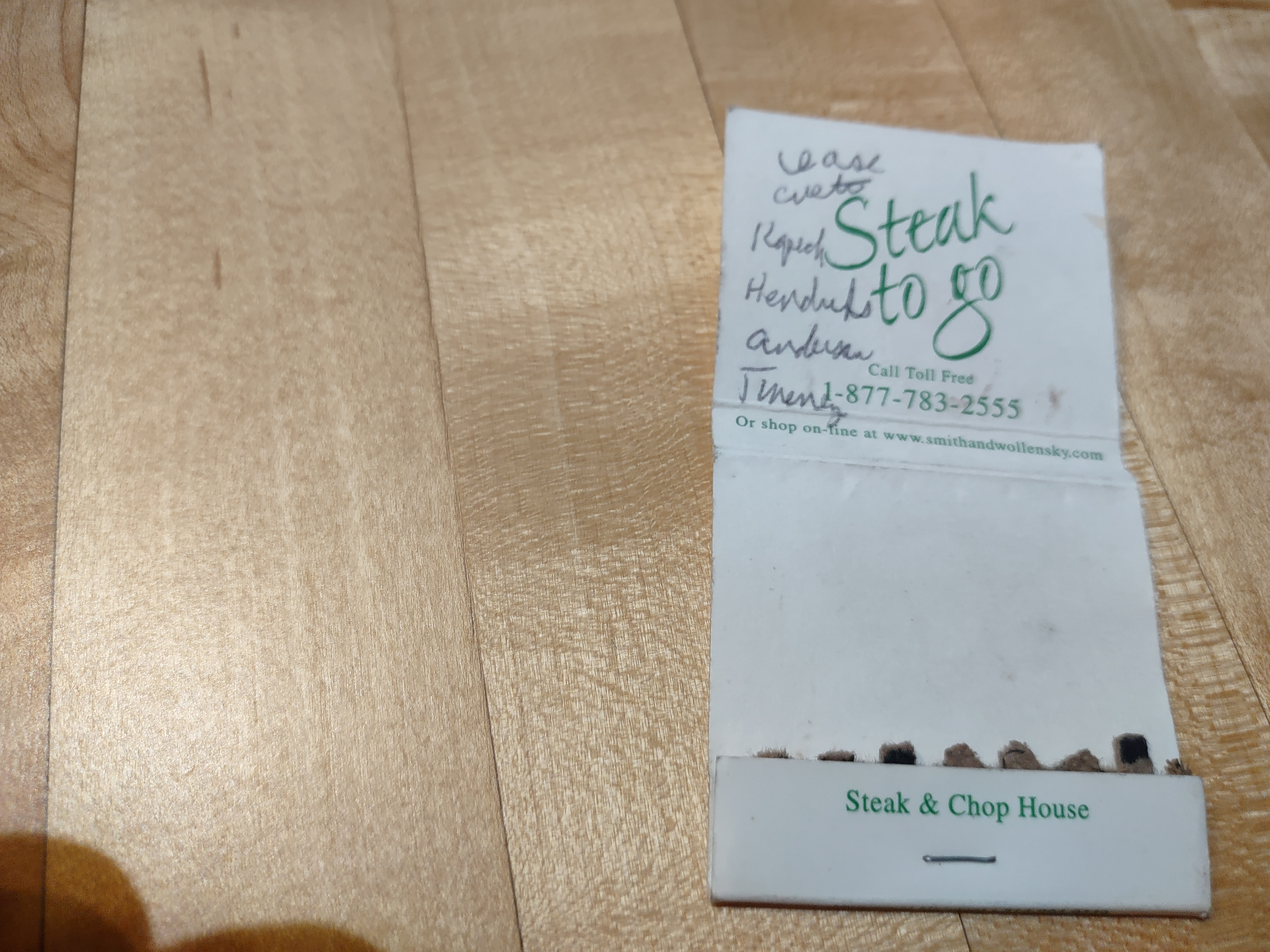
If you know my kids, you would be surprised to see that we had a matchbook from a steakhouse. My father and sister cabbaged onto matches from anyplace.
I have no idea why I was writing a lineup for the 2022 White Sox on a matchbook. Good Lord, I have piles of notepaper. I miss Cueto.
Stuff I’m Wearing Out
A good week for using up and wearing out. I realized I don’t need my work boots any more. My first jungle boots were real Army surplus vintage 1973. A tag said to shake the scorpions out before putting them on. I got these in the ’80s.

Hey, I used all the ink in a Bic pen.

You may think I have a pair like this one in my drawer. I don’t. I have six or eight other mismatched pairs. These are loose at the top and thin in the bottom. It would be abuse to keep wearing them.

William of Occam let me down
The simplest reason for Graham Nash, 81-year-old rocker about 50 years past his prime, to appear in stories in the New York Times and the New Yorker in the same week would have been his death. But you can’t always depend on the simplest explanation being the truth. Maybe I should have read the stories—turns out he is making a comeback. Man, old rockers make comebacks all the time—why should this be big news?
I really liked the Hollies, so I can say I cared about Carrie Anne and Carousel. Bus Stop is immortal. But later songs such as Marrakesh Express, Our House, Teach Your Children, Chicago/We Can Change the World, and Immigration Man (to name a few) run together in their mediocrity.
I remembered Stop, Stop, Stop was about a belly dancer. I looked it up—it’s a light-hearted tune about serial sexual assault. It’s no Stray Cat Blues, but I don’t imagine it gets much airplay today.
 converselyspeaking